Enhancing Bubble Removal in Geometry-Optimized Electrodes
Abstract
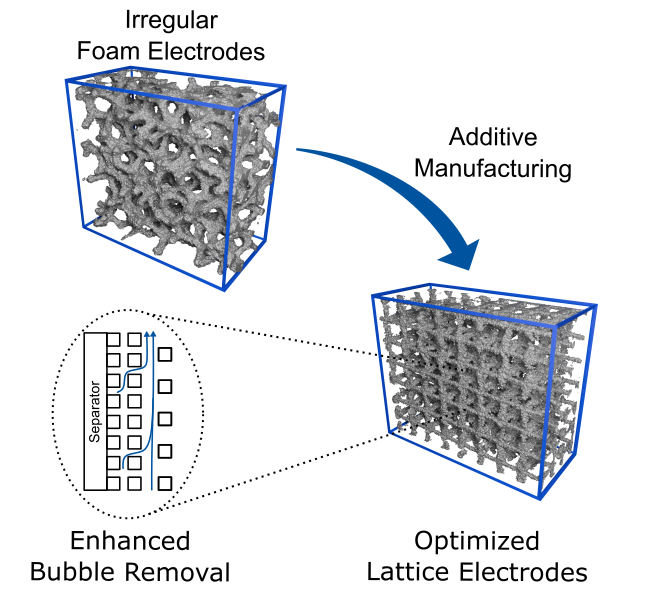
This study evaluates 3D-printed lattice electrodes against conventional stochastic foams for alkaline water electrolysis (AWE). Although additive manufacturing has enabled the introduction of deterministic, structured electrodes, a key question remains unresolved: how to disentangle the effect of architecture from concomitant changes in surface area and material. We therefore fabricated and tested stainless steel lattices with characteristic dimensions of 500 and 800 μm and benchmarked them against foams with comparable pore sizes. Despite foams exhibiting 20%–25% higher surface area, the lattice electrodes consistently delivered lower cell voltages at current densities up to 1 A cm−2. Multiphase-flow simulations, together with a “negative-control” experiment using a deliberately disrupted lattice, show that straight flow channels—not surface area alone—govern the efficiency gains. These channels generate a Venturi-like entrainment that draws bubbles into the electrolyte stream, suppressing the bubble curtain that can render the interior of stochastic foams electrochemically inactive. Guided by this mechanism, we designed a functionally graded, two-layer lattice that decouples surface area maximization from gas evacuation and achieves the lowest cell potentials reported in this study. Overall, the results elevate bubble management from a secondary optimization lever to a core architectural design principle for high-current-density AWE.
This work demonstrates that geometry-optimized 3D-printed lattice electrodes achieve better electrochemical performance than conventional stochastic foams in alkaline water electrolysis, despite having lower surface area. The key innovation is the Venturi-like entrainment mechanism that improves bubble evacuation through straight flow channels.